
Anja from Daisy & Sunshine makes nature happy
This conversation with Anja Fischer is part of an interview series with women who, like me, feel a special connection to nature. Here I speak with a variety of women about their relationship with and love for nature.

Anja Fischer from Gänseblümchen & Sonnenschein talks to us about smudging and the Rauhnächte (Rough Nights)
Smudging with natural materials is a part of her daily life all year round.
Who are you and what do you do?
I'm Anja from Gänseblümchen Sonnenschein (Daisy Sunshine), I'm sitting here in my kitchen in Altenmarkt im Pongau, but I was born in Graz. I work as a freelance editor, author, and herb fairy. My main profession is also herbs, and writing about them is what I love to do most. I work on many small projects that often complement or overlap.

I used to have a part-time job, but that ended, and so I threw myself into self-employment with full force.
I also have 2 young children, my daughter is 7 years old and is in first grade, and my son is 4 and goes to kindergarten.
How did you get into herbs?
I don't have a romantic story like many others. I didn't run through meadows with my grandma to pick arnica. Rather the opposite, nature didn't play a big role in my childhood and youth. I do know the classics from my mom, like spruce tip syrup or vinegar wraps, and grandma always had marigold ointment at home.

But I only really got into herbs later. I was on vacation with my husband in Großarl and we went on a herb walk. It fascinated me so much and I enjoyed it so much. But at that time I was a flight attendant, and it was impossible to combine such a training course with my schedule. But when I was pregnant with my daughter, I seized the opportunity and started a herb training course.
I then completed my herb training as a traditional European medicine practitioner at TEH. I was able to do my course in Lungau; we were a very small group of 10 or 12 women. The training lasts about 9 months, and it was a really great experience. My entire pregnancy was a herbal topic. Initially, I only applied the knowledge for myself and my family and had no business plan yet.
But little by little, more and more friends and mothers came to me, also wanting a cold balm or marigold ointment from me. But it's not that simple; you can't just produce and sell everything in Austria; there are regulations and rules for that.
So I invited those who were interested into my kitchen and offered to mix everything together. That's how it all started, with workshops. Moms from playgroups came to me, and we mixed and made products together.
We've been living in Altenmarkt for 4 years, and I started holding these workshops here as well.
How did smudging come into play?
The TEH training is a good basic education and touches on all topics that herbs bring with them, and smudging is also a part of that. But I started smudging much earlier, although I also read a lot about it, because smudging has a lot to do with experiencing and observing, and it's also very individual in terms of perception. Scents are very individual and trigger different things in every person. It's always very interesting to observe in smudging courses how differently people perceive scents and fragrances. Smudging has always captivated me, and making my own smudging mixtures is something very exciting and beautiful for me.

When did you start observing the Rauhnächte?
For me, it started in the last 5 years. Many things – like smudging on Christmas Eve – are a tradition for many. It's not about the Rauhnächte themselves, but about the custom. The Rauhnächte are celebrated very differently by many. Because there are no fixed ceremonies for them, it's very open and individual. I grew up without much tradition as a child, and only learned about these customs 14 years ago when I moved to Salzburg.

What do the Rauhnächte mean to you?
For me, the most important Rauhnacht is St. Thomas Night, which is the winter solstice on December 21st. This night marks the turning point, and things begin anew; the days get longer again. Even if it will still take a long time at that point, you can reflect on new beginnings and the start of a new era.
Three years ago, Karin and I, rather by chance, started offering an online Rauhnächte course. Karin is a mindfulness coach, and that's where I found my approach to meditation, and I showed her my approach to smudging.
Each day has a theme, and you can design your course very individually. You can also celebrate only one or two Rauhnächte, it's entirely up to you. I always try to look back and see with my family what was beautiful and what was good for us in the year.

Where does the custom of the Rauhnächte come from?
There are very different views on this. But it is assumed that smudging is as old as fire itself, and already in the Stone Age, people sat around the fire and sprinkled herbs into it. People sent wishes to heaven with it or were grateful for hunting results.
However, it also says that the solar year with its 365 days was contrasted with the lunar year. The lunar cycle is shorter than the solar cycle, and these 12 nights were then called the Rauhnächte. Nights, because at this time it is always darker than light for longer.
Every culture has developed its own customs and rituals related to smudging. After all, smudging is practiced all over the world.

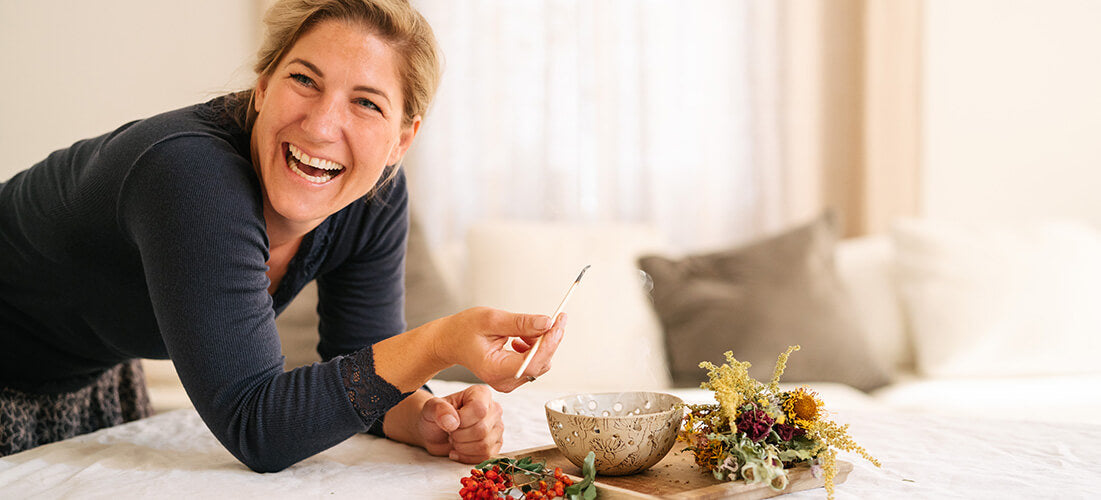
There's no need to be afraid of smudging; it's a very subtle practice that can do you a lot of good. You can do it all year round, it's not limited to the Rauhnächte. I also smudge every day, especially with the burner in my clay bowl. Furthermore, it's important to me to use herbs and roots from my local environment, because those are the ones that suit us best.
How do you handle the smudging ingredients?
In the morning, when I come into the kitchen, I take some incense from my drawer and place it on my burner. I have my own herbs from the garden, but also from the forest and the surrounding nature; I collect and dry them and save them for a smudging. Then I also have incense blends that I sell. For myself, I do it very intuitively.
Where do you get all your knowledge about what each plant does?
That's part of my training, and a lot of knowledge has accumulated over the last 8 years. In the last 2 years, I also completed the FLN herb expert training, where we went through 400 herbs. The exchange with many wonderful herbalists also helped me a lot. I'm almost always immersed in the topic and read many books and magazines on it.

Give us a tip for those who say, this is exciting, but where should I start?
It's a good idea to find a book to start with. Daniela Dettling's "The Smudging Handbook" from Freya Verlag is a great place to begin. It's excellent for beginners, answering the most important questions: How do I smudge, what options are there, what do I need...
For smudging itself, you then have to try out what you like or prefer more. Do you prefer to smudge with charcoal or on a burner? Or do you prefer to use incense sticks, which are great for beginners, as you don't need much else for them.
You don't need smudging blends, you can start with single herbs. Like sage, for example, which is cleansing and brings fresh energy into rooms. You can also take a few spruce or fir needles from your Advent wreath and place them on your burner. You can also dry orange peels or apple peels and smudge them.
If you're unsure, an online or offline course is also a very good option for this topic. We always have the Rauhnächte course starting on December 21st.

What are your 3 favorite smudging herbs?
Juniper and elecampane are my 2 favorite herbs, and rowan berries. They have such a refreshing scent. They are also great as "wish berries" for smudging with children. You can then throw them into the fire and make a wish, which adds a magical element.
I also really, really like spruce resin and spruce needles.
When do you smudge?
All year round, summer and winter. In summer, more often outside, in the evening with the family. I always smudge. My children also enjoy it very much.
Kräuterwunderzeit - Herb Workshops & more
You also have the opportunity to attend herb workshops with me, and you can find current topics and projects on my website or on Instagram.
Photo credit: Barbara Pacejka
You can find more interviews about wonderful women and their connection to nature here:
Karin from Naturspirit
Stephanie from Atempause
Susanne from Naturzauberwerke
Tina from die Kräutermacherei
Melanie from Mint
Anja from Gänseblümchen & Sonnenschein
Andrea from Fermentista
Andrea from Yoga Cuisine
Marlies from Quendelgrün
Christine from Textpoterie
Doris from Mit Liebe gemacht
Alex from Die Kräutermadame
Bianca from Naturespiritauraspray
Gerda from Grüne Kraft
Judith from Seelenzauber

Written by Gudrun Stolz